Licensing rules change — deadlines move, fees adjust, and rules get amended. Every figure on this page came from the Florida Statutes, DBPR's own application instructions, or the state testing program, and every one of them can be updated after this page is published. The Florida Department of Business and Professional Regulation at myfloridalicense.com is the final authority. Treat this page as orientation, not legal advice — and confirm current requirements with DBPR before you spend a dollar.
Class A vs Class B: You Are Not Picking an Exam. You Are Picking a Ceiling.
Florida law splits air conditioning contractors by system size — and the split decides what you can legally bid for years.
Most people approach this decision backwards. They ask which exam is easier. The right question is: what work do I want to be able to bid in year five? Because the class you choose today is the addressable market you own tomorrow.
| License Class | What Florida Statute 489.105 Says | What It Means for Your Revenue |
|---|---|---|
| Class A Air Conditioning | Services are "unlimited" — install, maintain, repair, fabricate, alter, extend, or design central air conditioning, refrigeration, heating, and ventilating systems of any size. | No capacity ceiling. Light commercial, larger residential, multifamily, and bigger package units are all biddable. This is the license a growth plan is built on. |
| Class B Air Conditioning | Same scope of work, but "limited to 25 tons of cooling and 500,000 Btu of heating in any one system." | 25 tons is right where light commercial begins. A 30-ton rooftop unit is not yours to bid — not for lack of skill, but because the license says no. |
| Class C Air Conditioning | Business limited to the servicing of air conditioning, heating, or refrigeration systems. A legacy, service-only class. | Service and repair only — no installation contracting. If you hold one, DBPR publishes time-gated upgrade paths out of it. New applicants building a company should be looking at A or B. |
Source: Florida Statutes, s. 489.105(3) — definitions of Class A, Class B, and Class C air conditioning contractors. Read the statute. Confirm current text with DBPR before relying on it.
Per DBPR's published guidance, the upgrade paths are time-gated by years of active certification: Class B to Class A after one year, Class C to Class B after three, Class C to Class A after four. Read that again as a planner: the license you will need in 2030 is a decision you make now. Owners who plan growth without planning licensing discover the ceiling at exactly the moment they are ready to break through it.
Here is the honest trade-off. The Class B trade exam covers a narrower scope, and plenty of residential-only operators run profitable companies on it for a career. But if there is any version of your plan that includes light commercial — and in Central Florida's construction market there usually is — the difference between the exams is measured in study weeks, while the difference between the licenses is measured in revenue you can never bid.
Certified vs Registered: Statewide or Fenced In
Florida runs two parallel license types — and one of them caps your service area by law.
Under Chapter 489, a certified contractor has passed the Florida contractor examination, holds a certificate of competency from the state, and may "contract in any jurisdiction in the state" without fulfilling local competency requirements. A registered contractor fulfilled a local jurisdiction's competency requirements, registered with the state, and "may contract only in such jurisdictions."
- Certified means statewide. Orlando today, Tampa next year, Jacksonville after that — one license, no new competency hoops. Your service area is a business decision.
- Registered means fenced in. Your legal service area is the jurisdiction that issued your competency card, plus any adjoining locales that accept it. Expansion across a county line becomes a licensing project, not a marketing decision.
- The ground is shifting under local licensing. Since 2021, House Bill 735 has been phasing out most local occupational licensing in Florida's construction trades, with later bills (HB 1383 in 2023, then SB 1142) extending the wind-down deadlines into 2025 and moving specialty categories to the state. Air conditioning contracting itself remains state-regulated — but the direction of travel is unmistakable: toward statewide certification.
Go certified. The registered path can look faster from where you stand, but it welds a fence around your business at the exact moment you should be building one without walls. Every system we build with owners — lead generation, service agreements, recruiting — scales across a service area. A license that cannot cross a county line caps all of it at once.
What DBPR Actually Requires
From the Board's own certified application instructions. Every item, no padding.
- Be at least 18 years old. The statute's floor, not the hard part.
- Prove four years of experience — or an approved combination. DBPR counts one year as 2,000 hours, and publishes these paths: four years as a worker or foreman with at least one year as a foreman; a four-year construction-related degree plus one year of experience; or combinations of college credit and experience totaling four years, always including at least one year as a foreman.
- Military credit is real. Veteran combinations include three years of military service plus one year as a foreman, down to one year of service plus three years of field experience. If you served, this can shave years off the clock — document everything.
- Pass both state exams. Business & Finance plus your trade exam. Details in the next section.
- Show financial responsibility. Credit reports on you and your business from a nationally recognized agency. A FICO-derived score of 660 or higher demonstrates financial stability; below 660, the Board's current application instructions require a Board-approved 14-hour financial responsibility course, and Board rule has also provided a licensing bond mechanism. Confirm which applies to you with DBPR.
- Carry the insurance. Air conditioning contractors show proof of $100,000 public liability and $25,000 property damage coverage. Workers' compensation coverage — or a valid exemption, obtained within 30 days of licensure — is required on top.
- Submit electronic fingerprints. Mandatory background check, done through an approved vendor.
- Disclose and document. Background questions, and proof of satisfaction for any liens or judgments. Answer honestly — the Board reads these.
Source: Florida DBPR, Construction Industry Licensing Board — certified Class A air conditioning contractor application instructions, myfloridalicense.com. Requirements and fees change — verify the current application package with DBPR.
Owners grumble about the credit check. Look at what the state is actually doing: before it lets you hold customer deposits and sign contracts, it tests whether you can manage money. That is the same test the market will run on you every month you are in business — except the market's version closes companies. If your score is under 660, fix the underlying habits now, not just the number. The companies that die rarely die of bad workmanship.
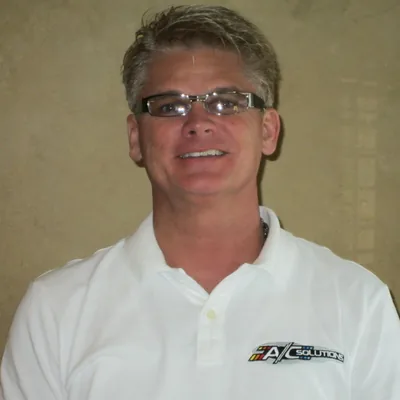
Leonard has spent 34+ years building, running, repairing, scaling and selling HVAC companies — starting his first from scratch in 1993 as the one man doing nearly everything. These systems were built under real pressure, with real payroll on the line. Not in a classroom.
Two Exams Stand Between You and the License
One tests the trade. The other tests whether you can run a company — and it is the one that predicts your future.
Florida's contractor examinations are developed under the state testing program run by Professional Testing (floridaexam.com) and delivered computer-based through Pearson VUE testing centers. You register with Professional Testing first — plan on roughly two weeks to get into the system — then schedule each exam with Pearson VUE when your authorization to test arrives.
- Business & Finance exam. Contracts, lien law, project management, accounting, insurance, employment rules. Roughly 120 questions per the testing program's published outlines.
- Trade exam. The air conditioning exam for your class — system sizing, code, installation, service, and safety, with Class A covering the unlimited scope.
- Built on a reference list. The exams are constructed around an official list of approved references. Buy the current editions, tab them, and learn to navigate them fast — the skill being tested is finding the right answer under time pressure, not memorizing a book.
- Passing is 70 or better. Per the testing program's published standard. Verify the current requirement when you register.
- Reschedule without penalty up to 72 hours out. Life happens; the fee does not have to.
Most candidates treat Business & Finance as the annoying half — the thing standing between a good technician and a license. Flip it. Lien law, job costing, cash management, and contracts are not exam trivia. They are the exact skills whose absence closes contracting companies. Study it like your company depends on it, because it will. The candidates who cram it and dump it end up learning it again in year two — at market prices.
On preparation: take a reputable exam prep course if you can. The math is simple — a few hundred dollars of prep against the cost of a retake, weeks of delay, and every week your company does not exist. Cheap insurance.
What It Costs and How Long It Takes
The fees are not the barrier. The four-year experience clock is — and it only runs once you plan it.
| Item | Amount | Notes |
|---|---|---|
| Exam registration | $135 | Paid to Professional Testing; covers getting you into the state testing system. |
| Exam scheduling | ≈ $40–$80 per exam | Paid to Pearson VUE per sitting. A retake means paying again — prepare once. |
| DBPR certified application fee | $245 or $145 | Depends on where you apply in the two-year licensure cycle, per the Board's application instructions. Non-refundable. |
| Fingerprints & credit reports | Varies by vendor | Electronic fingerprints through an approved vendor; credit reports on you and the business. |
| Insurance | Quoted to your business | $100,000 public liability / $25,000 property damage minimums for air conditioning contractors, plus workers' comp or exemption. |
| 14-hour financial responsibility course | If FICO under 660 | Board-approved course; pricing varies by provider. |
| Exam prep | Optional, recommended | Cheaper than a retake and months of delay. Treat it as the first line of your startup budget. |
Fee sources: DBPR certified application instructions (application fee) and the state testing program (registration and scheduling). All fees change — confirm the current schedule at myfloridalicense.com before budgeting.
The realistic timeline: if you already have the four years of documentable experience, the administrative path — registration, exams, application, review — is measured in weeks to months, not years. If you do not have the experience yet, the timeline is the experience, which is exactly why the license belongs in your career plan years before you need it. And if you are aiming at Class A through the upgrade route, remember the clock: one year of active Class B certification first.
Keeping It: Renewal and Continuing Education
The license is not a one-time event. Florida contractor licenses renew on a two-year cycle — certified licenses on the cycle ending August 31 of even-numbered years — and renewal requires 14 hours of Board-approved continuing education per cycle, with required hours spread across specified topics including workers' compensation, workplace safety, business practices, laws and rules, and an advanced Florida Building Code module. Verify the current topic breakdown with DBPR when you renew.
A lapsed license is the most expensive piece of forgotten paperwork in this industry — it can stop your permits, void your contracts, and stall your upgrade clock all at once. Put the renewal date on a calendar with a specific person's name attached to it, the day your license arrives. That is a system, and it costs nothing.
The Step-by-Step Path to Your Florida License
In order. Skipping ahead is how applications stall.
- Verify your experience path. Match your history against DBPR's approved combinations — four years with one as a foreman, degree-plus-experience, college-credit combinations, or military credit. One year equals 2,000 hours. Gather the documentation now; it is the most common stall point.
- Choose Class A or Class B — deliberately. Decide from the work you want to bid in five years, not the exam you want to take this month. The 25-ton line does not move for you later; only the upgrade clock does.
- Register for the state examination. Professional Testing at floridaexam.com, $135. Expect about two weeks to get into the system, then schedule with Pearson VUE when your authorization arrives.
- Pass Business & Finance and your trade exam. Study from the official reference list, take a prep course, and hit 70 or better. Treat Business & Finance as your company's first test — because it is.
- Get the financial file clean. Pull your own credit before DBPR does. At 660 or above, you are through. Below it, complete the Board-approved 14-hour financial responsibility course and confirm current requirements with the Board.
- Line up insurance and fingerprints. Bind the $100,000/$25,000 liability coverage, handle workers' comp or the exemption, and complete electronic fingerprinting through an approved vendor.
- Submit the application — then qualify your business. File the certified application with the fee for the current cycle. The license attaches to you; you then qualify the business entity you will actually operate under. Which raises the real question: what business? That is the next section.
The License Is the Permission Slip. The Business Is the Hard Part.
Everything above gets you legal. None of it gets you profitable.
Here is what almost every newly licensed contractor discovers in month four: the technical work was never going to be the hard part. You already fix equipment better than most people alive — that is why the state just licensed you. What ambushes you is quoting a job and finding out later it lost money. Chasing an invoice for six weeks. Realizing you paid yourself less than you earned as an employee.
The federal survival data says construction businesses rarely close because the owner could not do the work. They close on pricing and cash — the two decisions you can get right before you take your first call. The exam tested your trade knowledge. Nobody tests your pricebook, your billable-hour math, or your collections discipline. The market does that, and the market grades brutally.
- Before call one: know your true cost per billable hour — yours, not a former employer's. The real math is here, with a free calculator.
- Before call one: the six decisions — entity, insurance, financial separation, payment at time of service, a flat-rate pricebook, and what you will not do. The full license-to-launch playbook is here.
- Before month one ends: a written plan for the first 90 days — because a license with no plan is a job with worse hours.
You are not starting a job. You are starting a company that happens to perform HVAC work. Owners who understand that distinction on day one make different — and far better — decisions than owners who learn it in year three.
Licensing in Georgia, Texas, and Alabama
Every state draws the lines differently — and the lines are always business decisions in disguise.
Georgia licenses the trade as Conditioned Air Contracting through the Secretary of State, split into Class I (Restricted) and Class II (Non-Restricted). The Class I cap — 175,000 BTU of heating and 60,000 BTU of cooling — works out to exactly five tons, which puts most light-commercial work out of reach by law. The full breakdown, with verified fees and the revenue math, is on our Georgia page.
Texas runs a two-axis system through TDLR: Class A or Class B decides the size you can touch (Class B stops at 25 tons of cooling and 1.5 million BTU/hour of heating), while your endorsement decides the kind of system you can work on. Both axes cap revenue, and most owners only plan for one. We break it down on the Texas page.
Alabama licenses through the Board of Heating, Air Conditioning & Refrigeration Contractors — and unlike Georgia and Texas, its categories carry no tonnage split at all. Your ceiling there is capability and capital, not paperwork, which changes how growth planning works entirely. Details on the Alabama page.
Wherever you hold the license, the pattern is identical: the license class is a revenue ceiling written into law. Plan it like one. And if you operate here in Florida, the market context — the demand curve, hurricane season, the licensing upgrade clock — is on our Orlando & Florida page.
Florida HVAC Contractor License: Frequently Asked Questions
What is the difference between a Class A and Class B air conditioning license in Florida?
Florida Statute 489.105 draws the line by system size. A Class A air conditioning contractor's services are "unlimited" — any size system. A Class B contractor is "limited to 25 tons of cooling and 500,000 Btu of heating in any one system." Commercially, 25 tons is right where light commercial begins, so Class B locks you out of most rooftop and larger commercial work regardless of skill. If you hold Class B, DBPR's published upgrade path to Class A opens after one year of active certification — which makes the upgrade a planning decision, not a paperwork errand.
Do I need a state license to do HVAC work in Florida?
Yes. Air conditioning contracting is regulated under Chapter 489, Florida Statutes, through the DBPR Construction Industry Licensing Board. Contracting without the proper license is unlicensed activity and carries real penalties. There are two license types: certified (pass the state examination and work anywhere in Florida) and registered (fulfill a local jurisdiction's competency requirements and work only in that jurisdiction). With Florida phasing out most local occupational licensing since HB 735 in 2021, the certified statewide license is the durable choice for anyone building a real business.
How long does it take to get an HVAC license in Florida?
The long pole is experience, not paperwork. DBPR requires four years of proven experience — with at least one year as a foreman — or an approved combination of college credit, experience, and military service, where one year of experience equals 2,000 hours. Once you qualify, the administrative path is measured in weeks to months: roughly two weeks to get into the testing system after registering with Professional Testing, then exam scheduling through Pearson VUE, then DBPR application review. Plan the experience years deliberately; the rest is execution.
How much does a Florida HVAC contractor license cost?
From official and testing-program sources: exam registration with Professional Testing is $135, Pearson VUE charges roughly $40 to $80 per exam to schedule, and DBPR's certified application fee is $245 or $145 depending on where you are in the two-year licensure cycle. Add electronic fingerprints, credit reports for you and your business, and insurance — $100,000 public liability and $25,000 property damage for air conditioning contractors, plus workers' compensation coverage or an exemption. Budget for exam prep too; it is cheaper than a retake. Fees change, so confirm the current schedule with DBPR before you budget.
What happens if my credit score is below 660?
You can still get licensed. DBPR's application instructions require a credit report from a nationally recognized agency, and a FICO-derived score of 660 or higher demonstrates financial stability. Score below 660? The Board's current application instructions require completing a Board-approved 14-hour financial responsibility course, and Board rule has also provided a licensing bond mechanism — confirm the current requirement with DBPR. Do not treat this as a hoop. The state is testing whether you can manage money before it lets you hold customer deposits, and that is exactly the skill that decides whether your company survives.
Does military service count toward the experience requirement?
Yes. DBPR's application instructions publish veteran-specific combinations: three years of military service plus one year as a foreman; two years of military service plus one year as a foreman and one year as a worker or foreman; or one year of military service plus one year as a foreman and two years as a worker or foreman. One year of experience equals 2,000 hours. If you are transitioning out of the service, this credit can shave years off the path — document everything and confirm your specific record with DBPR.
Once I have the license, am I ready to start an HVAC business?
You are legally ready. You are not commercially ready — and the difference is where most new contractors get hurt. The license proves you can do the work; it says nothing about pricing jobs so they pay you, collecting at time of service, keeping business money separate from house money, or building a pricebook that holds margin. Federal survival data shows construction businesses rarely fail on technical skill — they fail on pricing and cash. Before you take your first call, make the six business decisions that protect your margin from day one. That playbook is the next page to read.